Facilitating EU Knowledge and Policy Frameworks Training for the Youth Sounding Board Ghana
On 8 May 2026 I facilitated Module 1 of the Youth Sounding Board Ghana capacity-building programme in Accra, covering EU institutions, EU decision-making and consultation entry points, and Global Gateway and NDICI-Global Europe.
30 September 20265 min read0 likes0 comments
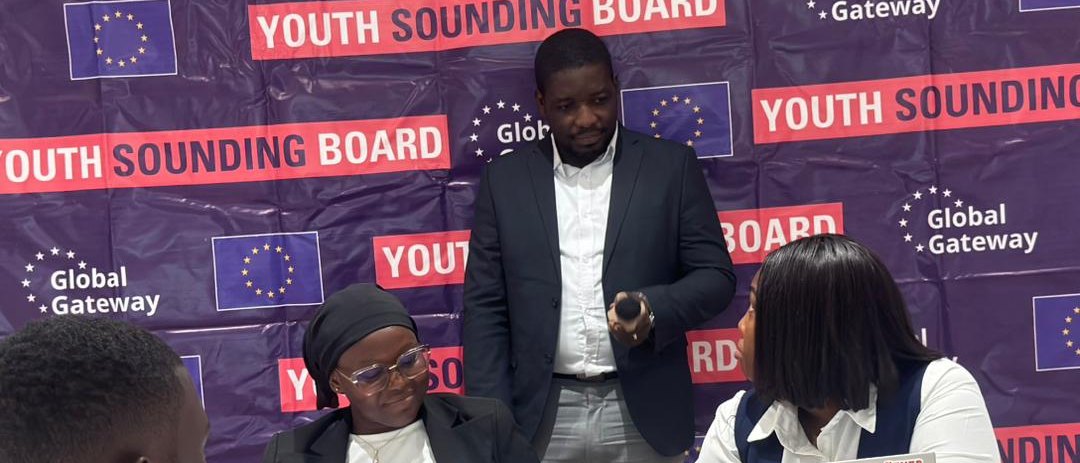
On 8 May 2026 I facilitated a one-day training for members of the Youth Sounding Board (YSB) Ghana at the San Marino Hotel, Osu, Accra. The session was Module 1, EU Knowledge and Policy Frameworks, of the YSB Ghana capacity-building programme. It was delivered under the EU-funded project Support to Youth Sounding Board and Youth Participation in Policy Dialogue in Ghana, implemented by Eurecna Srl for the Delegation of the European Union to Ghana.
Background
The YSB Ghana advises the EU Delegation on youth perspectives in its work in Ghana. Members had served on the board for about a year and had taken part in EU Delegation events, but had not yet received structured training together.
The content of the module was set by a training needs assessment carried out among the members, supported by focus group discussions and key informant interviews. It identified one priority gap: limited operational understanding of EU institutional structures and decision-making processes. The objective of Module 1 was to close that gap and show members where, and how, YSB input can realistically influence EU processes.
I was engaged by Eurecna as the facilitator for Module 1. My co-facilitator, Noah Bugre, delivered Module 2 on advocacy and policy product development.
Training content
The day was organised in three modules.
Module 1.A: EU Institutional Architecture. An overview of the European Union and the roles of its seven main institutions, followed by the bodies most relevant to the YSB: the European External Action Service, the EU Delegation to Ghana, and the European Economic and Social Committee and Committee of the Regions as formal channels for civil society.
Module 1.B: Decision-Making Cycles and Consultation Entry Points. The distinction between the EU legislative cycle, which makes laws, and the programming cycle, which allocates funding, and why the YSB's main leverage lies in the programming cycle. The session traced the programming chain from the Multiannual Financial Framework to NDICI-Global Europe, the Multi-annual Indicative Programme (MIP) for Ghana and the Annual Action Plans. It identified the pre-proposal stage as the point at which external stakeholders can contribute most effectively, and introduced the European Commission's Have Your Say portal, including how to set keyword alerts.
Module 1.C: Global Gateway and NDICI-Global Europe. Global Gateway as the EU's external investment strategy and its five priority sectors (digital, climate and energy, transport, health, and education and research); NDICI-Global Europe as the financing instrument behind it; Ghana's MIP priorities; and the Team Europe approach to delivery. The EU-Ghana cooperation framework, originally planned as a separate session by an EU Delegation officer, was incorporated into this module.
Methodology
The training used a participatory approach. Each module opened with learning objectives and a short poll on prior knowledge, moved through content supported by EU-Ghana examples, and closed with a group exercise and a knowledge check (Match-the-Institution, Sequence-the-Steps, and a True-or-False round).
Participants worked in groups organised by YSB thematic areas. Each group exercise ended with a two-minute presentation to plenary, framed as a briefing to the Head of the EU Delegation.
Group outputs
Each group produced three working documents:
- Institutional map: one priority youth issue, the three EU institutions most relevant to it, and an entry point for each.
- Engagement calendar: three EU consultation windows in 2026, with a YSB action and expected output for each.
- Global Gateway project pitch: a youth-focused project for Ghana in one Global Gateway sector, with objective, target group, partners and alignment to MIP Ghana priorities.
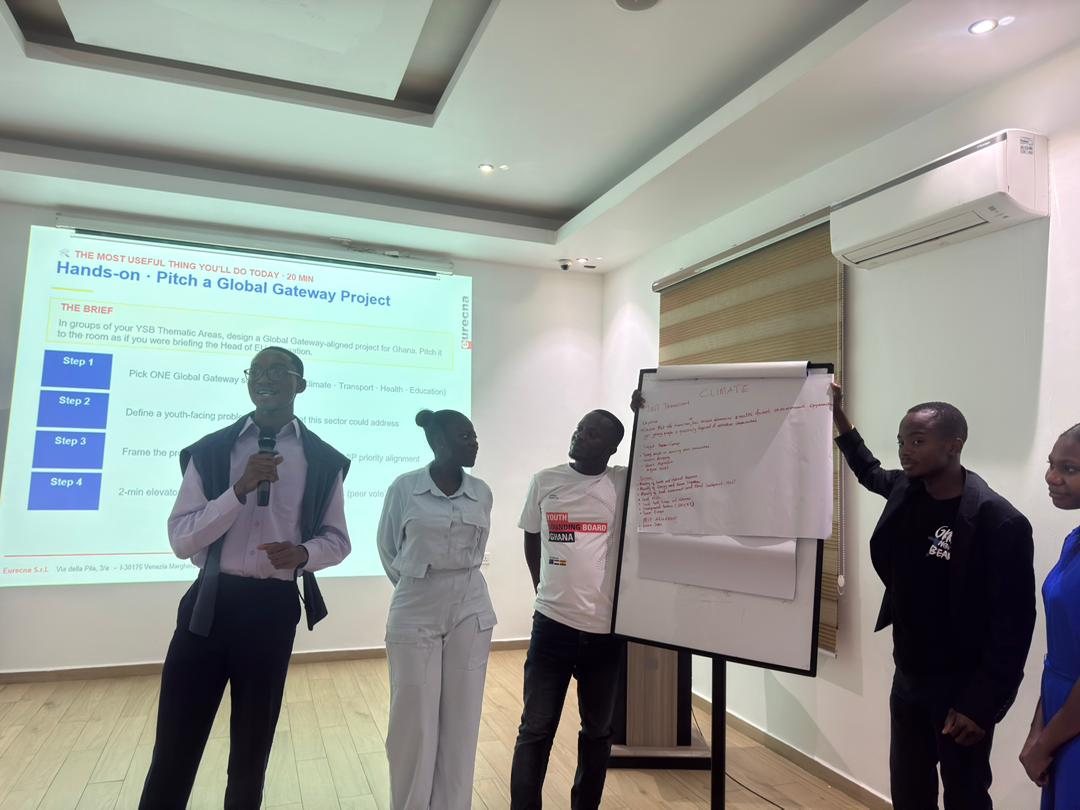
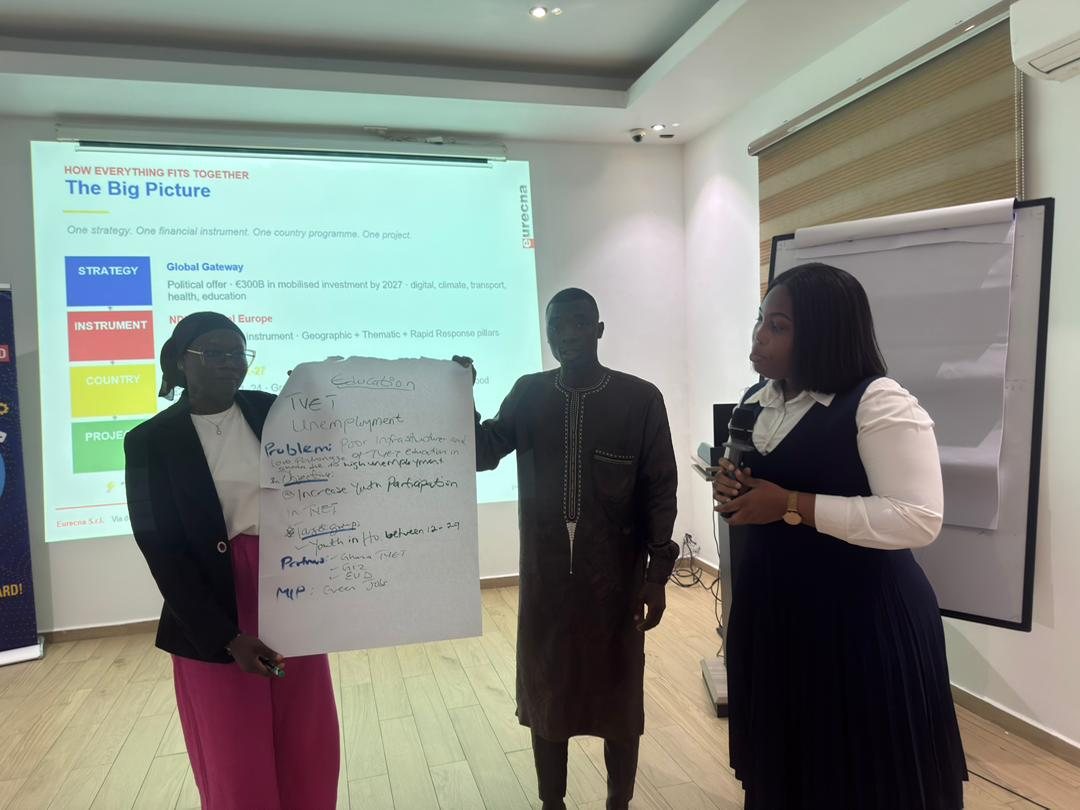
Issues addressed by the groups included education access, climate and renewable energy transitions, and youth economic inclusion. The education group, for example, presented a project on youth unemployment linked to technical and vocational education and training (TVET), identifying Ghana's TVET service, GIZ and the EU Delegation as partners and aligning it with the green jobs priority. Several pitches included Team Europe partners such as the EIB, GIZ and AFD.
Results
Eight YSB members completed the training and the post-training assessment.
- All eight participants answered all seven knowledge-check questions correctly (100%).
- Mean self-rated confidence, on a five-point scale, was 4.62 on Global Gateway and what it means for Ghana, 4.57 on the EU decision-making process, 4.50 on identifying entry points for youth engagement, 4.50 on EU-Ghana cooperation, and 4.00 on familiarity with EU-funded programmes in Ghana.
The lowest score, on programme-level familiarity, identifies the area for reinforcement in later modules. In written feedback, participants most often cited the EU decision-making cycle, the role of the EU Delegation as the entry point to EU institutions, and the distinction between Global Gateway and NDICI-Global Europe. Eurecna reported positive feedback on the training from both the EU Delegation and YSB members.
Recommendations
In the activity report I recommended:
- Retaining the participatory methodology for subsequent modules.
- Setting up a shared Have Your Say alert for the YSB covering Ghana, Africa, youth and NDICI.
- Complementary training in communication skills, project management, and monitoring and evaluation.
- A short orientation, led jointly by the EU Delegation and the YSB coordination team, to reconfirm the YSB's advisory role, representation protocols and the formal channels for submitting its positions.
Acknowledgements
I thank Eurecna Srl and the Delegation of the European Union to Ghana for the opportunity, Noah Bugre for the collaboration, and the members of the YSB Ghana for their participation.
Comments
Give a name or stay anonymous. Everything is read before it appears, so there is a wait between posting and publication.
No comments here yet. Yours would be the first.