Training on Strategic and Innovative Communication for Environmental Advocacy
In early September 2025 I co-led a two-day virtual training by UNIYIA on Strategic and Innovative Communication for Environmental Advocacy and Policy Impact, covering message design on day one and digital tools such as Flourish, Google Earth, Mentimeter, Kahoot and Canva on day two.
4 September 20254 min read0 likes0 comments
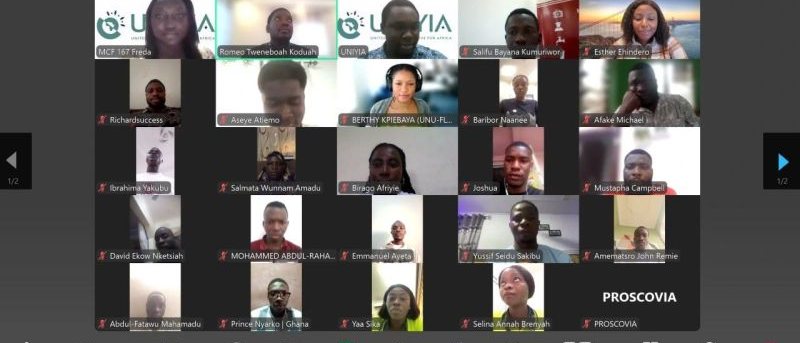
In early September 2025 I co-led a two-day virtual training organised by the United Youth Initiative for Africa (UNIYIA) on Strategic and Innovative Communication for Environmental Advocacy and Policy Impact. The training brought together a cohort of environmental advocates and moved from communication strategy on the first day to practical digital tools on the second. I facilitated alongside Lyzianah Emakoua, Esther Ehindero and Worship Joshua Frimpong.
The premise of the training was simple. The climate crisis does not lack data; what is often missing is the ability to communicate that data in a way that people understand, accept and act on.
Day 1: Building a powerful message
The first day dealt with how an effective advocacy message is built. Communicating on climate is not a matter of releasing facts and hoping they land. It requires a deliberate structure, which we worked through in four parts.
1. Know your audience. Every message starts with the people it is meant for. A community group, a district assembly, a ministry official and a social media audience have different concerns, vocabulary and decision-making power. We discussed how to identify the audience, what they already know and value, and what would make them listen, so that messages are tailored rather than one-size-fits-all.
2. Use plain language. Scientific and policy language is precise, but often inaccessible. We worked on translating technical terms into clear, relatable language without losing accuracy: replacing jargon with everyday words, using concrete examples instead of abstractions, and explaining figures in terms people can picture, such as costs to a household or impacts on a familiar place.
3. Frame it as a narrative. People remember stories more readily than statistics. We looked at how to frame an issue with a clear structure: the situation, the problem and who it affects, and what can change. A narrative makes an abstract issue such as emissions or water stress tangible, and gives the audience a reason to care.
4. End with a clear call to action. A message that raises concern without saying what to do leaves the audience with nowhere to go. We emphasised closing every message with a specific, achievable action suited to the audience, whether that is signing a petition, adopting a practice, attending a meeting or changing a policy.
Day 2: Digital tools for advocacy
The second day moved from strategy to practice, introducing digital tools that help advocates present evidence and engage audiences. For each tool we looked at what it does and where it fits in an advocacy workflow.
Flourish is a data visualisation platform for building interactive charts, maps and animated stories from spreadsheet data, without coding. For environmental advocacy it is useful for turning datasets, such as rainfall trends, emissions or energy access figures, into visuals that can be embedded in reports, websites and presentations.
Google Earth allows users to explore satellite imagery, compare locations over time and build guided map-based stories. In advocacy it can show change on the ground, such as deforestation, coastal erosion, mining or urban expansion, in a way that is difficult to dispute and easy to follow.
Mentimeter is an interactive presentation tool for live polls, word clouds and questions. It turns a presentation into a two-way exchange, lets facilitators gauge what an audience thinks in real time, and gives quieter participants a way to contribute.
Kahoot is a quiz-based learning platform. It is well suited to workshops, school sessions and community trainings, where a short competitive quiz can test understanding of key concepts and make learning more engaging.
Canva is a design platform with templates for infographics, posters, presentations and social media graphics. It allows advocates without design training to produce consistent, professional material that communicates a key message at a glance.
Participants applied these tools in practice during the session, beginning to sketch audience-focused campaign ideas that combined the messaging principles from day one with the tools introduced on day two.
Key point
The training reinforced a view I hold firmly: strategic communication is not a supplementary soft skill but a core competency for environmental advocacy. It is what turns awareness into action and evidence into policy impact.
Acknowledgements
Thanks to Noah Bugre for the opportunity to speak and for putting the training together, and to my co-facilitators Lyzianah Emakoua, Esther Ehindero and Worship Joshua Frimpong for their contributions. Thanks also to all the participants for their engagement.
Comments
Give a name or stay anonymous. Everything is read before it appears, so there is a wait between posting and publication.
No comments here yet. Yours would be the first.